


Vi Xuyen, Ha Giang
THE HA GIANG BORDER PATROL ROAD
Seven tiers of switchbacks, and what a road cost
There is a road in Ha Giang that we rarely put in our promotional photographs.
Not because it isn’t beautiful. Because every time we stop there, saying less feels closer to right.
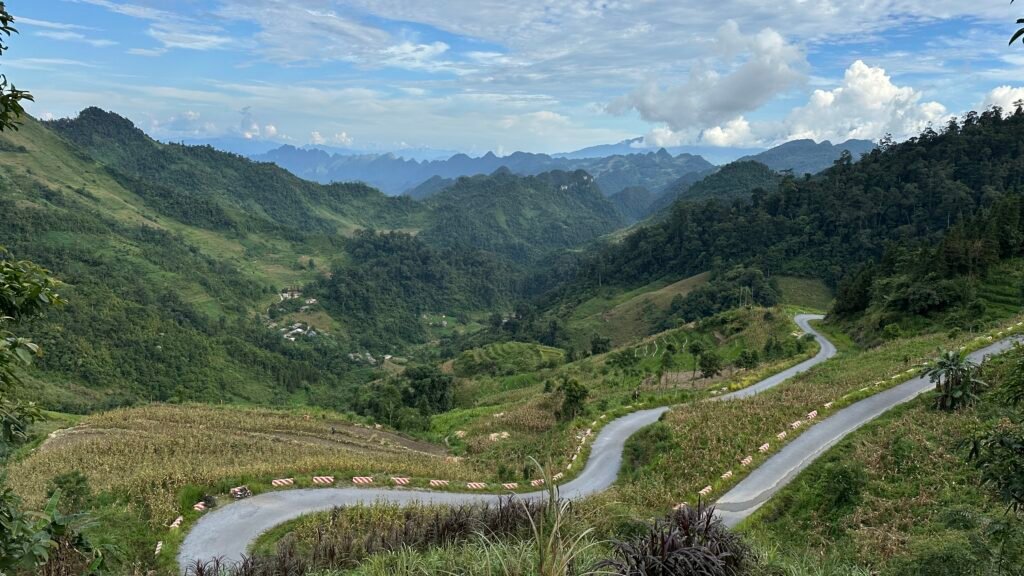
A white thread strung across the mountainside
Late afternoon, the Ta Van – Lao Chai stretch. Look closely at the middle of the frame and you will see a white thread strung across the mountainside, then losing itself, then reappearing one tier higher, then vanishing again behind a rock face.
People here call it the seven-tier pass — seven times the road has to fold back on itself before it can crawl over a single mountain.
Everyone who passes says the same thing: “Like a painting.”
But this road was not born to be beautiful.
It is a border patrol road
A border patrol road follows the national boundary, linking the posts, the outposts, the border markers. It leads to no check-in spot. It is there because the border is there.
And on this strip of land, the border was once a line of fire.
Vi Xuyen
In February 1979, war broke out along the entire northern border.
But for Ha Giang, 1979 was only the beginning. From April 1984 to May 1989 — for more than five years — the Vi Xuyen front was the fiercest remaining battleground of the war to defend the northern border. Nine main-force divisions passed through here in turn.
Something few people notice: Lao Chai, Ta Van, Thanh Duc, Xin Chai, Thanh Thuy — names that sound so peaceful on today’s tourist map — are precisely the border communes the front ran through. The road you are riding does not look across at the battlefield from a distance. It lies inside it.
The figures, left as they are, without comment:
- More than 4,000 officers and soldiers fell at the Vi Xuyen front.
- More than 9,000 were wounded.
- More than 2,000 sets of remains still lie somewhere in the rock, not yet recovered.
- Over three days, more than 100,000 artillery shells fell on one stretch of mountain.
- Height 685 was shelled more than three metres lower, its rock ground to white powder. The soldiers called it “the lime kiln of the century”.
12 July 1984, campaign MB-84. Within twenty-four hours nearly 600 officers and soldiers fell, most of them from the 356th Division. Ever since, 12 July has been the day of remembrance for the battle — veterans from across the country return to Vi Xuyen to burn incense for their comrades.
Heights 1509, 1100, 772, 685, Doi Dai, Co Ich, Bon Ham — on a military map they are only numbers. To those who were there, each number is a name.
Who opened the roads here
In those years, roads were opened so troops could reach the outposts, so ammunition and rice could be carried up, so the wounded could be carried down.
Opened with hoes. With shovels. With explosives. And with shoulders — the shoulders of the engineer corps, and the shoulders of Hmong, Dao and Tay porters from the very villages where we stop today for a drink of water.
The concrete patrol road you ride today is the work of another generation: the first sections in 1994, then a large-scale programme approved in 2005, planning some 10,000 km along the whole land border — also built by army engineers, also hugging the rivers and the mountainsides, also in the hardest places.
Two generations, one task: keeping a road along the border.
Seven tiers of switchbacks are a thousand refusals to surrender to a mountain.
Up there, now
Terraced fields in their young green.
A small wooden hut.
Clouds turning pink at dusk, quiet enough that you can hear the water running through the paddies.
Children walk home from school along the edge of the road. A man leads his buffalo around the bend and nods to a stranger.
That is the most remarkable thing about this road: it has gone back to being an ordinary road.
How we ride this route
We ride slowly. We stop at the one bend where all seven tiers are visible at once.
And before anyone raises a camera, the guide will tell the story — briefly — of what happened here. Not to weigh the journey down. But because a beautiful photograph taken in this place, if the person taking it knows nothing, is only a mountainside with a winding road on it.
For guests who want to go deeper, the journey can include the Incense Altar 468 in Thanh Thuy commune — looking straight across at the old heights — and the Vi Xuyen National Martyrs’ Cemetery, with 1,970 graves and 2 collective graves. We do not put these two stops in the default itinerary. Those who wish to go, we take, and we allow enough time that no one has to hurry.
In the evening the group sleeps in the village. Dinner is cooked by the host family. Some stories are only told beside the fire, by the elders of the village — and no guide can tell them in their place.
A few things to know if you ride the border patrol route
Papers. This is a border area, not an ordinary tourist road. Vietnamese citizens should carry their national ID card. Foreign visitors need a border-area permit issued by the provincial police, together with their passport (under the regulations currently in force, Decree 299/2025/ND-CP). Ha Giang Experts handles all of this before the trip.
Photography. Landscapes, freely. But no photographs of border posts, guard stations, barracks or military vehicles; for the boundary markers, ask your guide first. Always follow the instructions of the Border Guard at checkpoints.
The road. Narrow, single-lane in places, no barrier, a drop on one side. Fog can come down very fast after 4 p.m., leaving visibility of a few metres. We do not ride this route after dark, and we do not accept solo riders.
One rule with no exceptions. Some areas that were once battlefields are still being cleared of mines and unexploded ordnance. Do not leave the track. Do not pick up any unfamiliar piece of metal. This rule has no exceptions.
And one thing that is in no regulation. If you come across a stone marker or an incense bowl set by the roadside, slow down. That alone is enough.
Finally
“The peace we are looking at — it did not come of its own accord. The blood of those before us soaked into this pass.”
We bow our heads to those who remain here.