

A cultural report — Ha Giang Experts
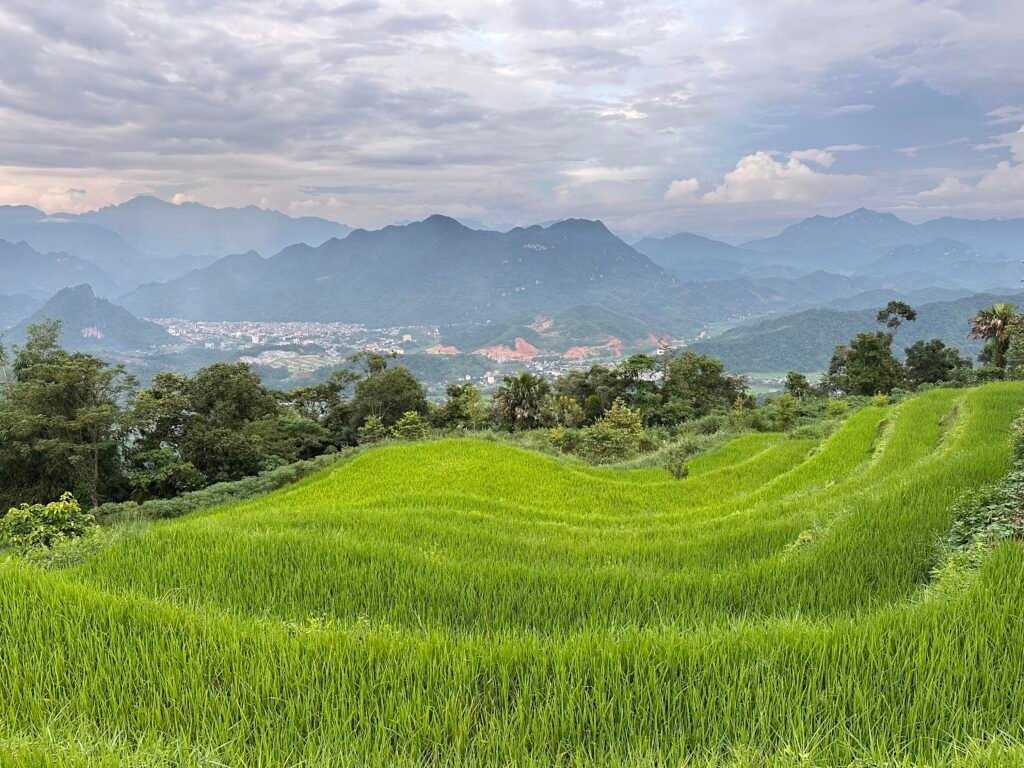
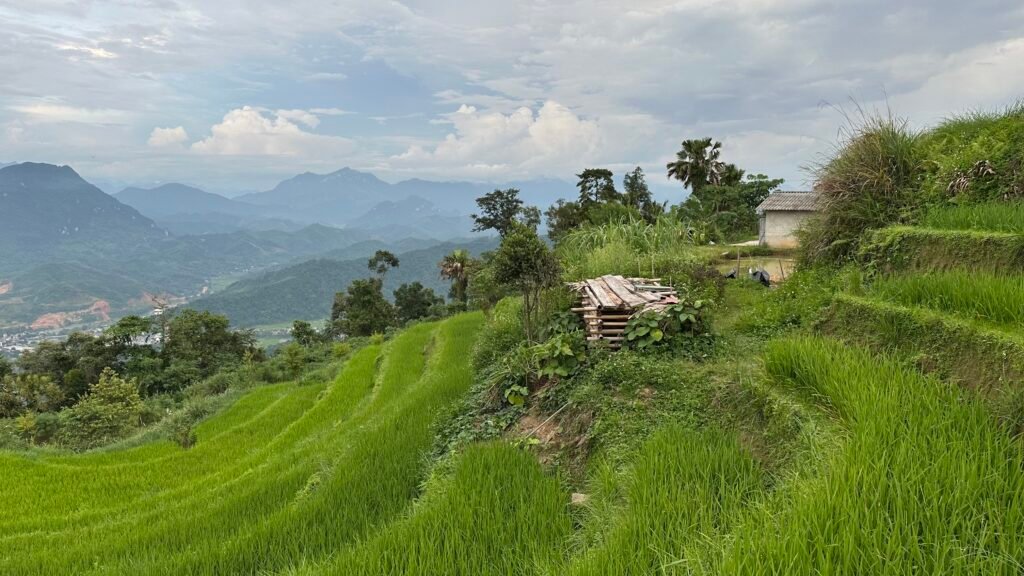
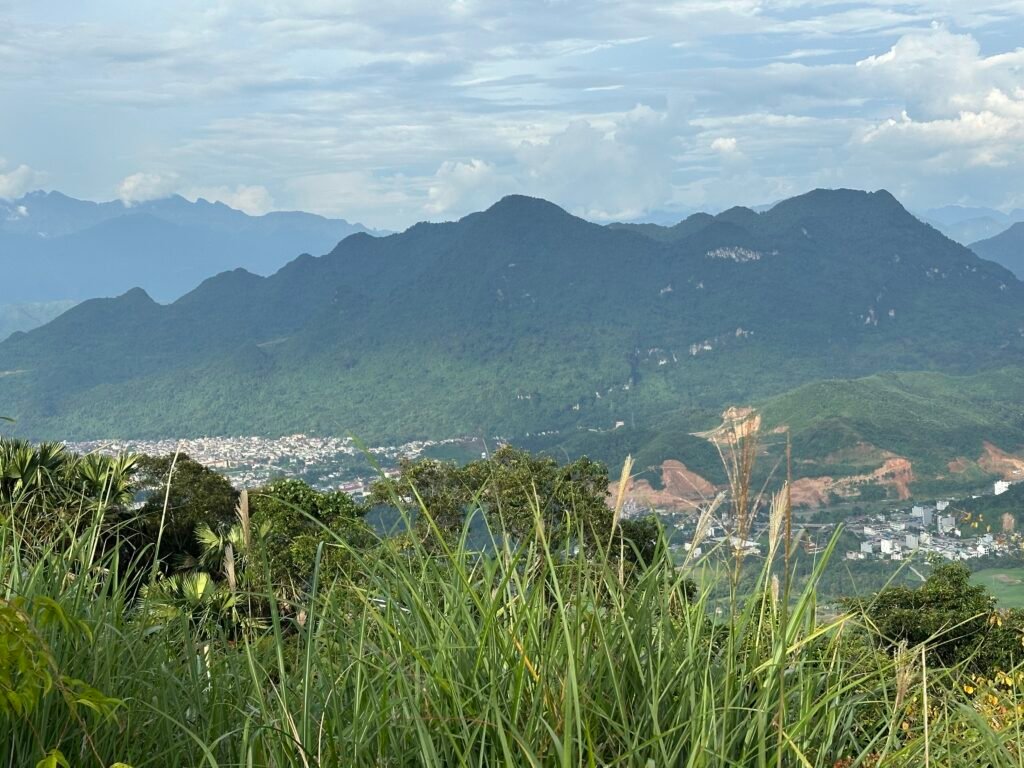
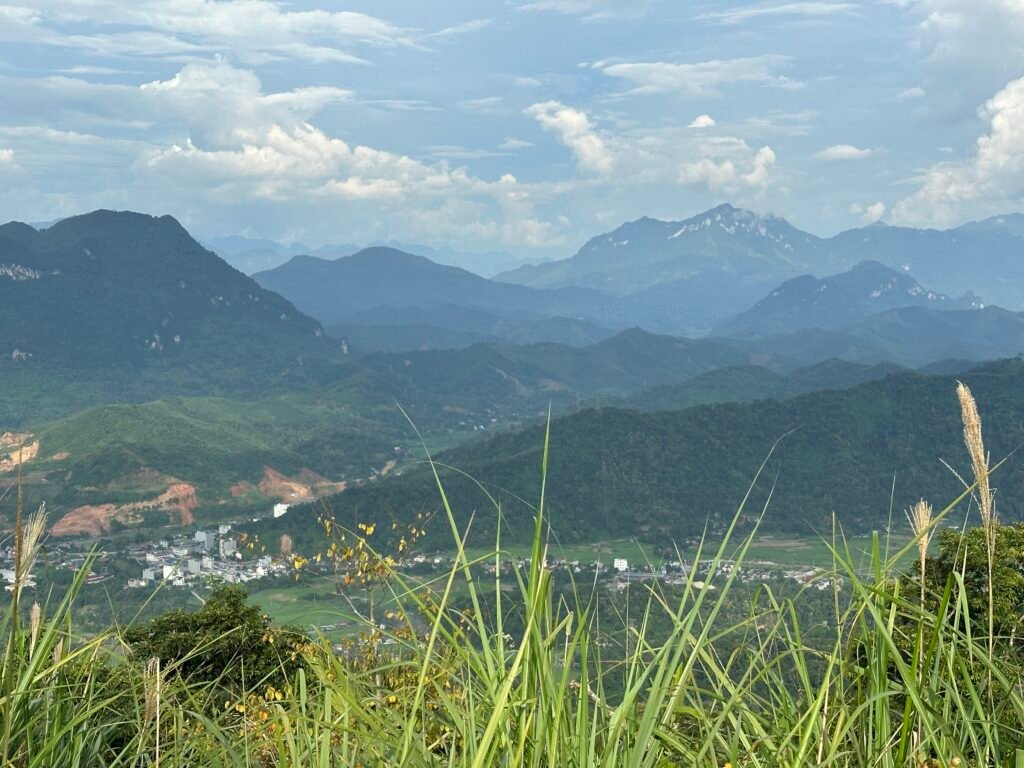
We left Ha Giang city while the mist still lay over the terraced fields. Our destination was a handful of Red Dao hamlets perched on the flanks of the Tay Con Linh range — the roof of the northeast — where moss-covered stilt houses shelter among palm groves and ancient shan tuyet tea trees. This time we were not going up to climb a summit, but to celebrate the mid-year festival of the seventh lunar full moon with the villagers, a holiday which for the Dao here matters no less than the Lunar New Year. And it was during those days in the hamlet that we finally understood how a small rice cake can hold the whole philosophy of a community.
Up to the hamlets at mid-year Tet
The road up to the Red Dao hamlets on Tay Con Linh is not easy — steep reversing bends, with sections where a motorbike has to be dropped into a low gear to haul itself over the pitch. The compensation is that the higher you climb the cooler the air becomes, and the smell of cooking smoke starts to drift out of the first houses, hanging in the mist. That was how we knew we had timed it right: the whole hamlet was busy preparing for the mid-year Tet.
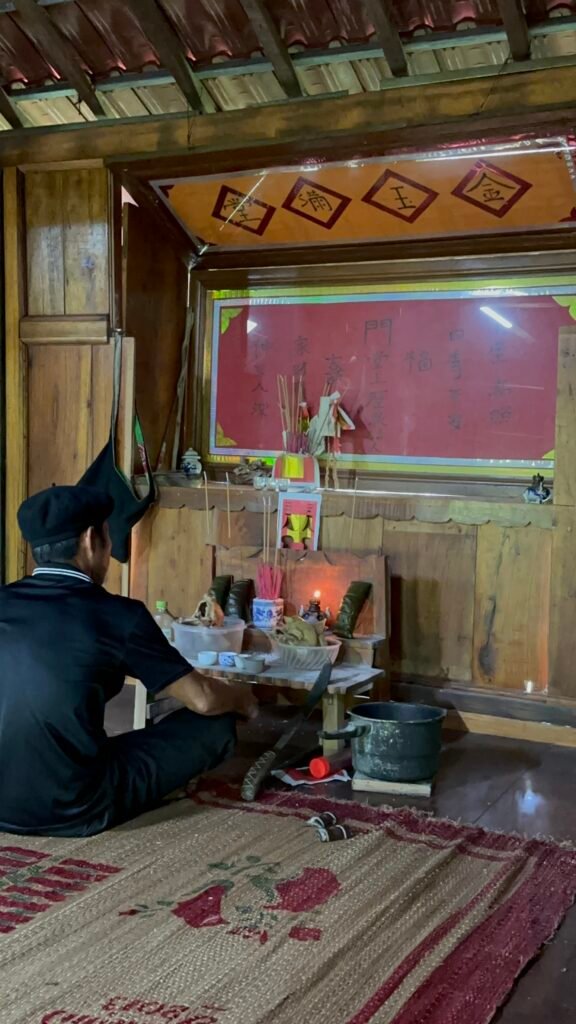
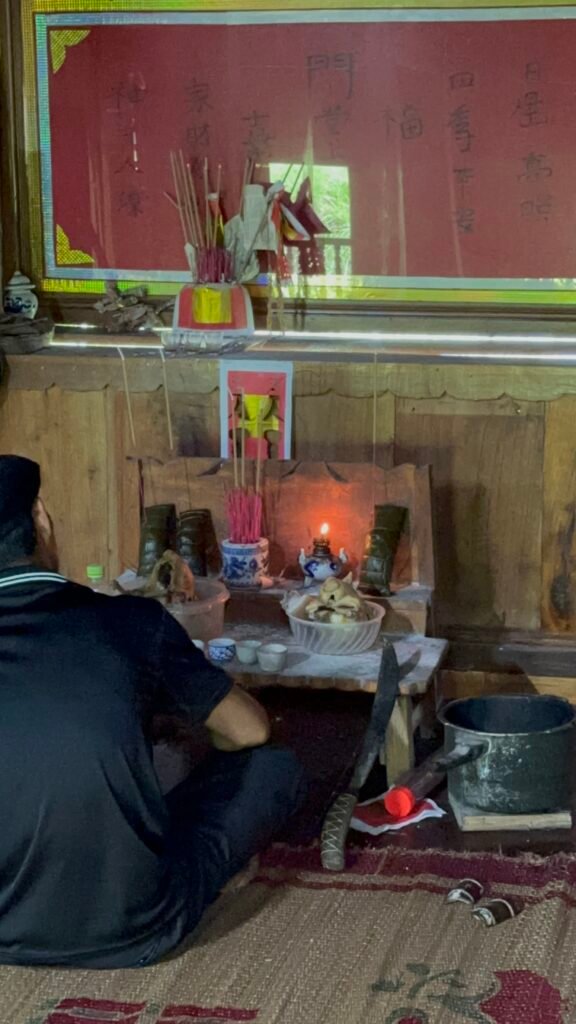
For the Dao, the seventh lunar full moon is not simply the day of forgiveness for wandering souls as the Kinh generally understand it, but a complete festival with two important days. On the 14th, the families of a lineage gather to make offerings to their ancestors and to the wandering dead; on the 15th — the festival proper — smoke rises from every kitchen at once, and children, friends and neighbours go from house to house exchanging good wishes, exactly as they would on the first morning of the Lunar New Year. We arrived at the busiest moment of all: the wrapping of the cakes.
By the fire, listening to grandmother explain “du vay”
A Red Dao family invited us in, and we sat around the hearth in the middle of the stilt house while three generations worked through baskets of glutinous rice, dong leaves, mung beans and village pork. The woman of the house wrapped cakes at speed while explaining the strange name the villagers use: “du vay”.
In the Dao language, she told us, “du vay” means to cook for a long time, to simmer thoroughly — which is exactly what making this cake requires. The pot must stay on the fire continuously, sometimes for almost a full day, and in her experience the longer the cakes are kept hot, the softer and better they turn out. No recipe and no clock is more accurate than the hands and eyes of a woman who has wrapped these cakes for dozens of festivals.
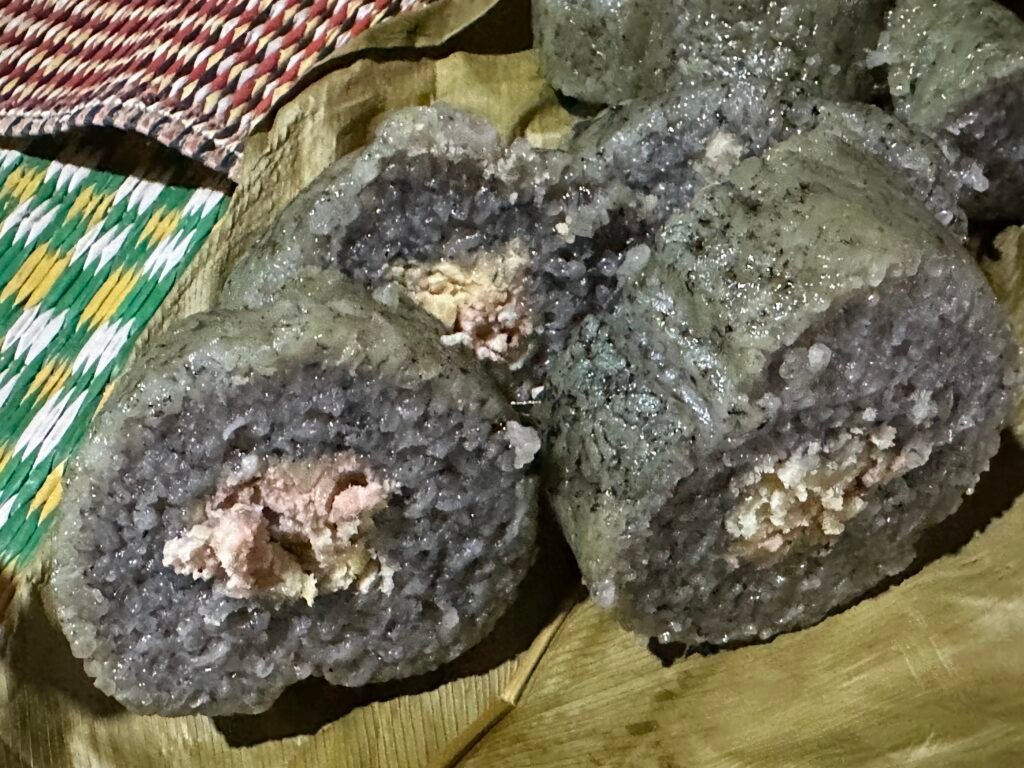
One detail struck us particularly. The glutinous rice is not merely soaked in water as it is for an ordinary banh chung: for the seventh-month offering, the straw of the glutinous rice plant itself must be burnt, the fine ash sifted out, and the rice soaked together with it before wrapping. The technique is close to the black banh chung tradition found among other Dao groups across the northern mountains, where the ash of glutinous rice straw is treated as irreplaceable — turning something that looks like waste after the harvest into part of the soul of a festival cake.
Skilled hands, and a shape that carries a wish
Watching her work, we realised that the du vay cake has a shape quite unlike the cylindrical banh tet of the Kinh or the famous evenly curved “hunchback” banh chung of Ha Giang. In the traditional fold, the centre of the cake is built up into a hexagonal ridge while both sides slope away lower.
That is not accidental, she said, laughing. The raised centre stands for growth, for the hope that the children of the house will grow up and make something of themselves; the lower sides stand for humility and for the steady support that holds everything up. Each small cake is therefore a quiet blessing that parents and grandparents fold into their children’s hands before it is placed on the ancestral altar, asking the ancestors in turn to look after them.
A day beside a bubbling pot
The cakes are stacked into a large pot, set over the wood fire in the middle of the house, and from then on the day is one long wait. The children run out every so often to check the flames, the adults take turns feeding the fire, and nobody is allowed to let it go out. The scent of dong leaves and glutinous rice mixes with the smoke and fills the stilt house, along with the talk and laughter of neighbours dropping in with their good wishes.
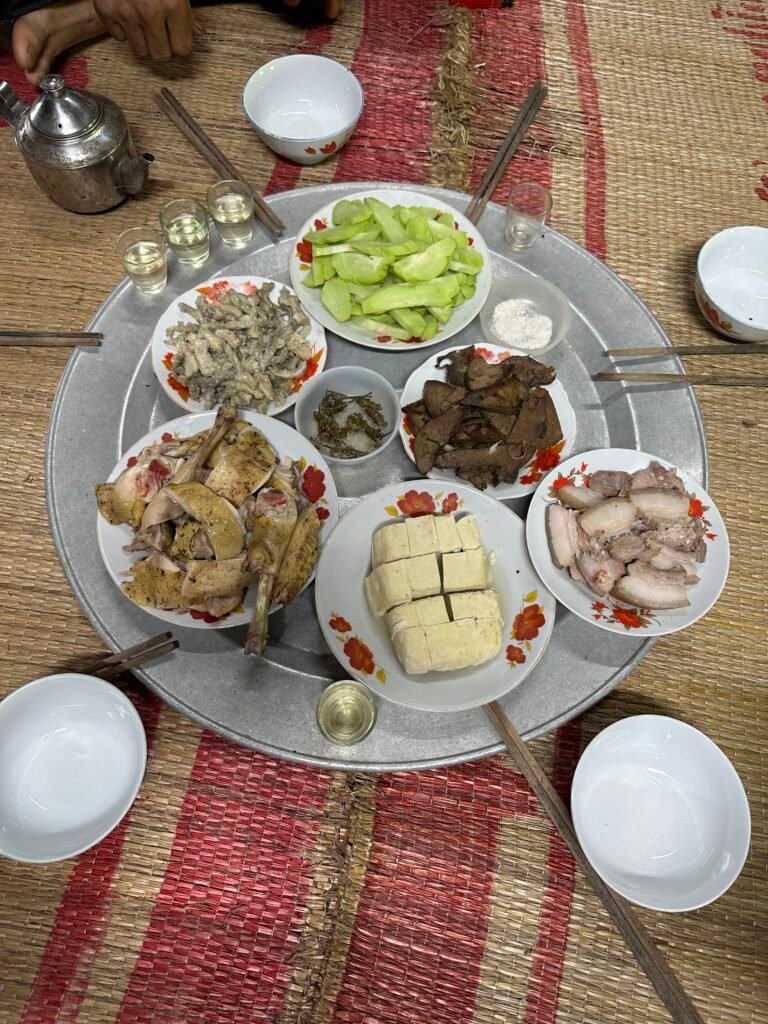
By evening, when the first cakes came out of the pot, we were invited to taste them there at the fireside — a dense, sticky wrapping, a filling of mung bean and rich village pork, saturated with woodsmoke in a way no lowland banh chung ever is. It is the taste of a long day of waiting; the taste of “du vay” in the full sense of the word.
One festival, many layers
Talking with other families in the hamlet, we learned that du vay cakes do not appear year-round: they belong only to the two greatest occasions, the Lunar New Year and the mid-year festival of the seventh full moon. Other dates have their own dishes — plain steamed sticky rice at the first full moon, three-coloured sticky rice on the third day of the third month, sticky rice with sugar filling on the sixth day of the sixth month. Precisely because it appears at only two moments in the year, the du vay cake is both an offering to the ancestors and the reason a whole lineage and a whole hamlet come together.
We left the hamlet in the dark, in the rain, close to the following day, after wrestling our way through seven or eight meals in a single day — you cannot refuse, because up here one house invites you and the next pulls you in to celebrate too — each of us carrying a few du vay cakes that our host had wrapped for us to take back down. But what we carried away most of all was the plainness and warmth of the welcome, and the understanding that behind a simple dish there is always a whole view of the world: about patience, about family, and about the hopes people fold into the next generation.
If you would like to experience the mid-year Tet with the Red Dao on the slopes of Tay Con Linh for yourself — sitting by the fire, wrapping a du vay cake with your own hands — let Ha Giang Experts take you there.